What does Colmar look like at Christmas?
Colmar is a small town in Alsace, in eastern France, surrounded by vineyards. Its old half-timbered houses, painted pistachio green, salmon and butter yellow, lean over quiet canals. The corner by the Lauch river is called Petite Venise, “Little Venice”: long ago, many houses could be reached by boat.
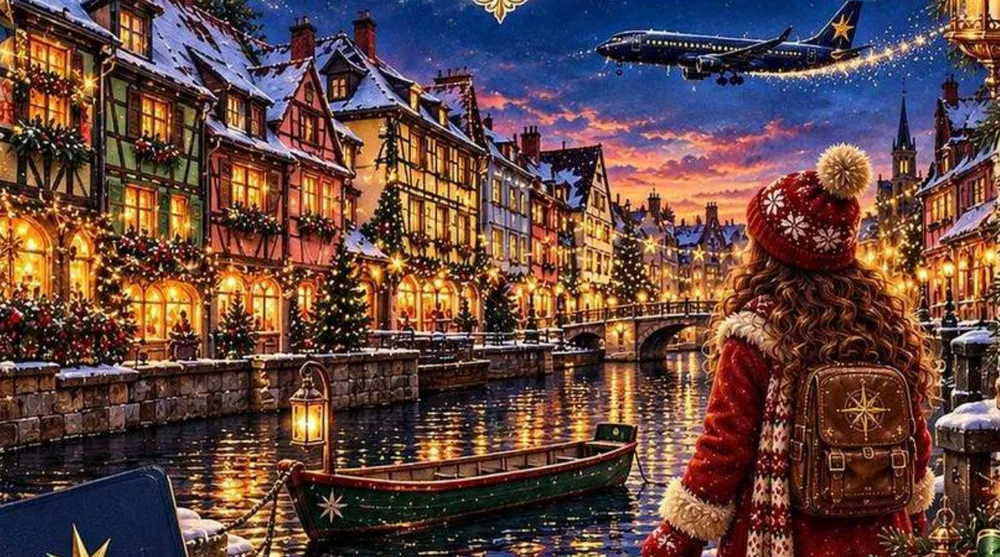
The children’s market in Petite Venise
Colmar has several Christmas markets, but one belongs to the children. In Petite Venise, forty-three colorful huts line the path, full of wooden toys, sweets and little decorations. There is a nativity scene to admire, a carousel with painted horses and a giant mailbox for letters to Père Noël. The markets usually run from late November to late December.
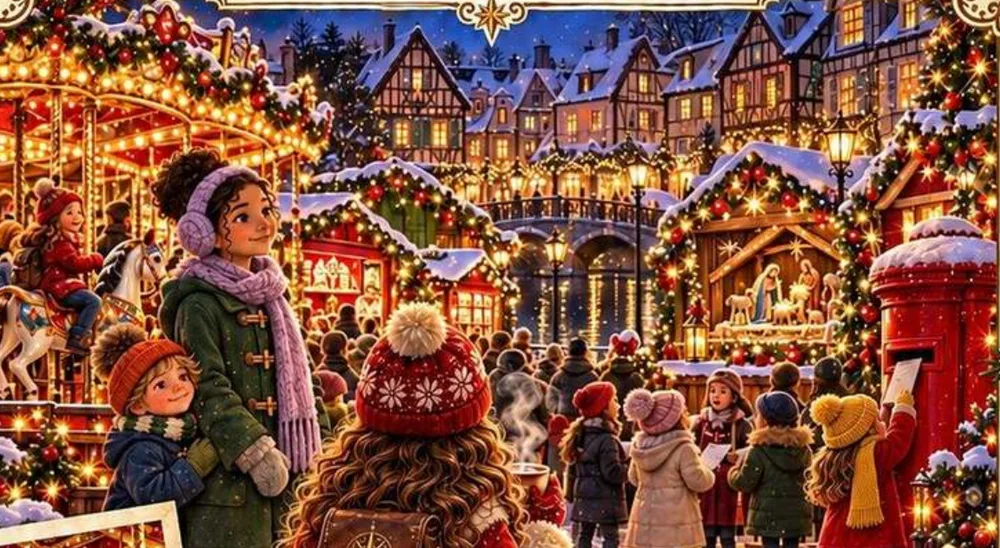
What do you find at the market?
- Wooden toys and little tree decorations.
- Sweets and star-shaped cookies.
- A carousel with painted horses.
- Warm apple juice with cinnamon, cloves and orange, with no alcohol.
What can you do at the market?
- Write a letter to Père Noël and post it in the giant mailbox at the children’s market.
- Listen to the carols on the boats: during Advent, children’s choirs climb into lit boats, glide through Petite Venise and sing for the people on the bridges.
- Find the House of Heads, built in 1609 and covered with more than a hundred little carved faces: some smile, others frown.
- Look at the stained glass of the Dominican Church, made in the 1300s, shining like jewels above the wooden huts.
Two Christmas customs from Alsace
Carols on boats
During Advent, children’s choirs from schools and music schools climb into lit boats and sing carols on the water. If the weather is too bad, the boats wait for another evening.
A tree from 1521
In 1521, the town of Sélestat, not far from Colmar, wrote in its account book a payment to the foresters who guarded the forest before Christmas, when the trees were cut. It is the oldest known written mention of the Christmas tree tradition.
A taste of Alsace: kougelhopf
Kougelhopf is a soft brioche cake with raisins, baked in a tall fluted mold with almonds on top. Many families eat it on holiday mornings, dusted with sugar. Its recipe and the one for warm spiced apple juice, to make together with an adult, are in the book.
How do you say “Merry Christmas!” in French?
Joyeux Noël!
Try saying it at dinner on Christmas Eve.
What word did Mira discover here?
In each of the eleven cities of the second journey, Mira finds a special word. The word from Colmar is written in her Christmas passport, at the end of chapter 6.