What does Budapest look like at Christmas?
Budapest is the capital of Hungary, built on both banks of the Danube: Buda, with its castle hill, and Pest on the other side. In the evening the Danube shines dark blue, and the bridges stretch across it like strings of gold. On the bank stands the Parliament, a huge white building with many slim spires and a tall dome.

The Vörösmarty Square market
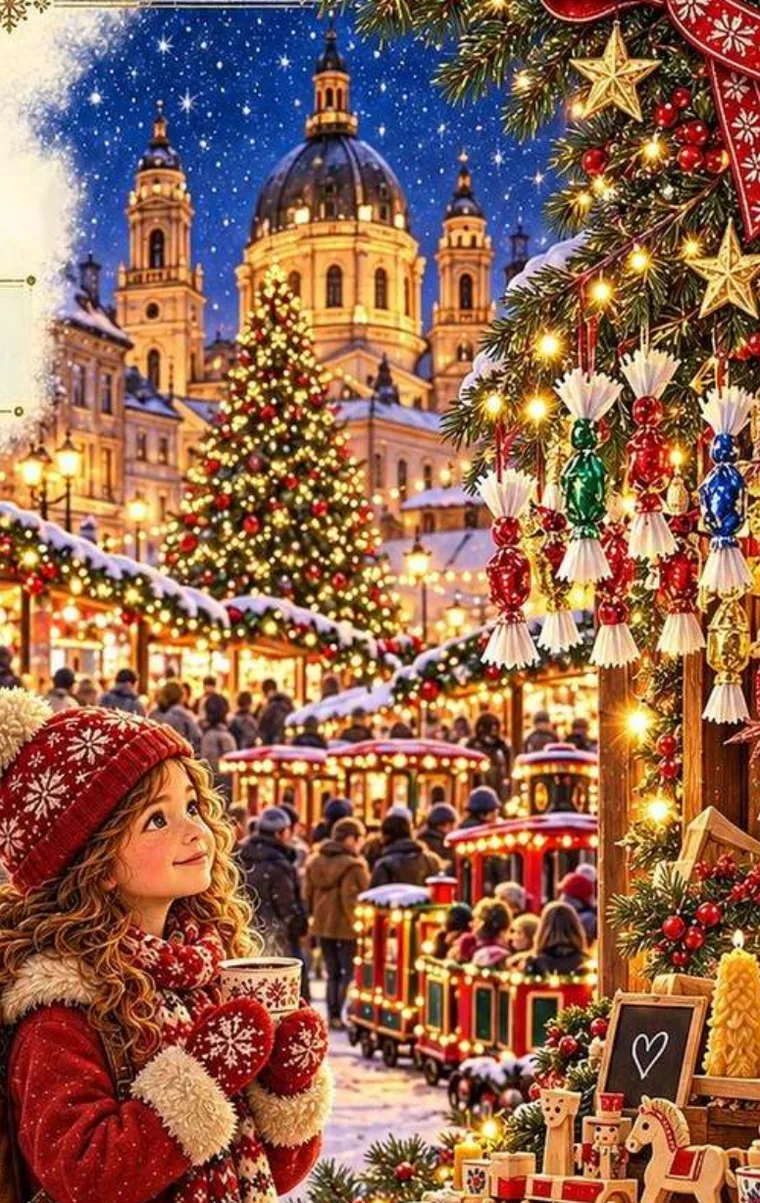
Rows of wooden stalls shine under garlands of lights in Vörösmarty Square, and a tall tree rises in the middle of the crowd. Here almost everything is handmade, and some makers work right at their stalls while children watch. The air is warm from roasted chestnuts and kürtőskalács, chimney cakes turning slowly over the embers. The market usually runs from mid-November to New Year.
What do you find at the market?
- Painted pottery, wooden toys and embroidered cloth.
- Candles that smell of honey.
- Kürtőskalács, chimney cakes baked over embers.
- Szaloncukor, shiny sweets in colored foil with fringed paper ends.
What can you do at the market?
- Ride the lit tram: during Advent, an old tram covered with thousands of fairy lights runs along the river. You ride it with an ordinary ticket.
- Cross the Chain Bridge, opened in 1849, the first permanent bridge between Buda and Pest. Four stone lions, added in 1852, guard its ends.
- Look at St. Stephen’s Basilica: during Advent, colorful light pictures dance on its front, and children skate in the square below.
- Watch a maker at a stall working clay or wood.
Two Hungarian Christmas customs
Mikulás and the polished boots
On the evening of 5 December, children polish their boots and put them in the window. By morning, Mikulás has filled them with sweets, nuts and fruit.
Saint Lucy’s Day
On 13 December, families plant wheat in a bowl so it turns green by Christmas. Long ago, some people started carving a “Lucy’s chair” that day, working on it a little each day until Christmas Eve.
A taste of Hungary: bejgli
Bejgli are soft rolls of sweet dough filled with walnut or poppy seed. An old belief says poppy seed brings plenty and walnut keeps troubles away. The recipe for the walnut roll and for a warm mug of apple and cinnamon, to make together with an adult, are in the book.
How do you say “Merry Christmas!” in Hungarian?
Boldog karácsonyt!
Try saying it at dinner on Christmas Eve.
What word did Mira discover here?
In each of the eleven cities of the second journey, Mira finds a special word. The word from Budapest is written in her Christmas passport, at the end of chapter 10.