What does Kraków look like at Christmas?
Kraków is a city in southern Poland, on the Vistula river, and for hundreds of years it was the capital of the Polish kings. At its heart lies the Main Square, Rynek Główny, one of the largest medieval squares in Europe. In winter, the two brick towers of St. Mary’s Basilica and the golden arcades of the Cloth Hall shine above the wooden huts, and the snow settles on the roofs.
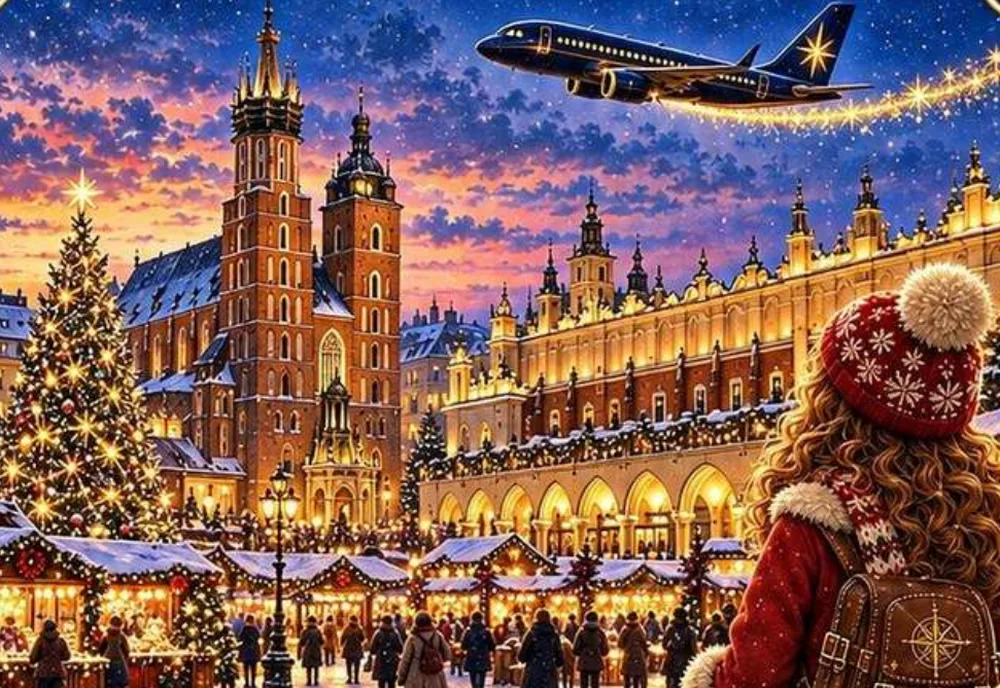
The Main Square market
The Christmas market is held in the Main Square, around the Cloth Hall (Sukiennice), where merchants once sold cloth under the arcades. The wooden huts stand in long rows, their roofs heavy with snow and garlands, and the air smells of warm honey and wood smoke. The market usually runs from late November to early January.
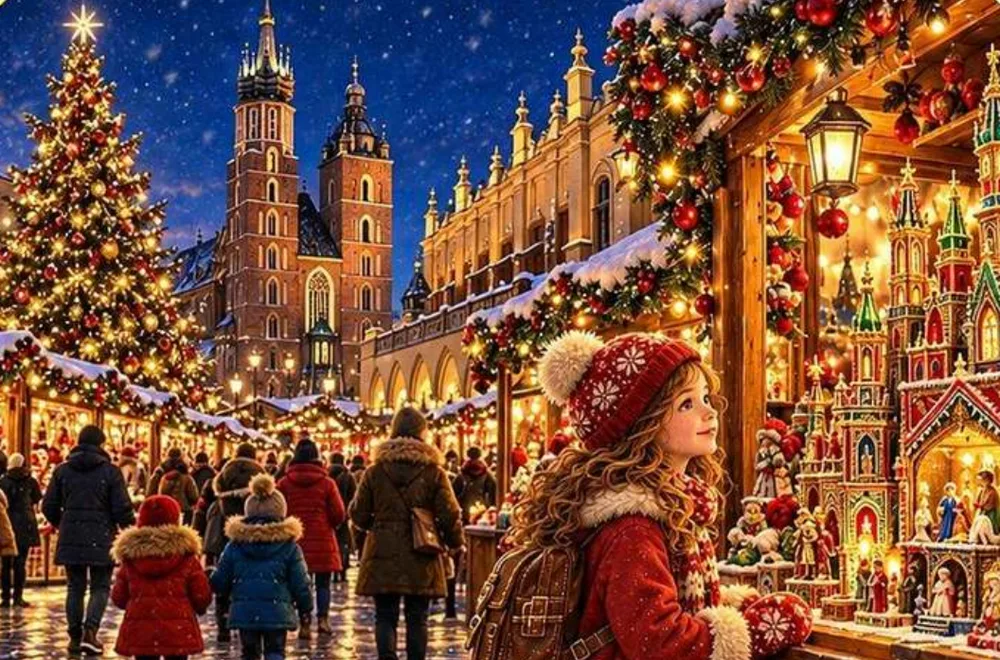
What do you find at the market?
- Nuts in warm honey, sold in paper cones, perfect for cold evenings.
- Painted glass baubles and ornaments that turn the lantern light into little rainbows.
- Szopki, little palaces of the Nativity in gold, red and green, made of cardboard and shiny foil.
- Carved wooden angels and wool mittens in every color.
What can you do at the market?
- Listen for the trumpeter in the tallest tower of St. Mary’s Basilica: every hour he plays the hejnał, a tune that stops suddenly in the middle.
- See the szopki at the monument: on the first Thursday of December, the makers bring their szopki to the Main Square, to the Adam Mickiewicz monument, for the big contest.
- Warm up with honey nuts from a wooden hut and walk under the arcades of the Cloth Hall.
- Walk up to Wawel Castle and look for the bronze dragon at the foot of the hill, which breathes real fire every now and then.
Two Polish Christmas customs
Wigilia and the first star
In Poland, Christmas Eve is called Wigilia. Dinner begins when the first star appears in the sky, in memory of the Star of Bethlehem. Often a little hay is placed under the tablecloth and an extra plate is set for the unexpected guest.
Opłatek, the shared wafer
Before dinner, everyone shares a thin white wafer. Each person breaks a piece from the other’s wafer and wishes them something good for the year ahead.
A taste of Poland: pierniki
Pierniki are honey and spice gingerbread cookies, cut into hearts and stars and decorated with white icing. Some are eaten, others are hung on the tree. Their recipe and the Christmas Eve compote of dried apples, pears and plums, to make together with an adult, are in the book.
How do you say “Merry Christmas!” in Polish?
Wesołych Świąt!
Try saying it at dinner on Christmas Eve.
What word did Mira discover here?
In each of the eleven cities of the second journey, Mira finds a special word. The word from Kraków is written in her Christmas passport, at the end of chapter 1.